Leica Repair

Some time back, I bought a Leica IIIf**, a 1955 model (one of the final ones produced - the III series was discontinued after 1960). It’s one of the last of the original Barnack-style Leica rangefinder cameras. I’d wanted one for a while, but to be honest the main reason I got it was that for a Leica with a lens it was absurdly cheap, and came with a 3.5cm lens which I knew I could use on my other rangefinders.
I had researched which Barnack Leica to get for a while, and landed on the f or g models as suiting my needs best while keeping that beautiful Barnack styling.
When I tried a roll in it, I found that the shutter timing was good but whenever I had the shutter at high speeds such as 1/250 or 1/500… it looked wrong. You can see for yourself what it looked like. Streaks horizontally all through the images.

I did a lot of searching on the net, and eventually at the bottom of a forum thread from a time long past (2007) I found several people talking about this issue. It was described as being caused by fraying of the cloth shutter. The poster had fixed the issue by opening up the camera and carefully shaving back the edges of the shutter.
This seemed simple enough, but I felt disinclined to open a camera I’d spent a grand on whose company still does professional repairs, so I put it back on the shelf. When I did get a quote on the camera repair, it was understandably expensive. As a result, this beautiful camera stayed sitting on my shelf for many months, waiting until I had the spare cash to send it off for repairs.
A year later…
Recently, I began to get annoyed seeing such a beautiful old camera sitting on my shelf unused, and began to consider having a go at repairing it myself.
I have repaired cameras before, but it’s not really my thing. It’s fiddly and I spend the whole time paranoid I won’t be able to put everything back in place, or I’ll lose one of the notoriously tiny screws, springs or other parts cameras have in them.
The other night, however, I decided “Well, fuck it. If it’s going in for repairs anyway, I can’t make it much worse.” It was a very hopeful thought. (And fortunately one that turned out to be true.)
I opened it up, and to my delight found precisely what the poster had described - visible fraying at the edge of the cloth shutter.

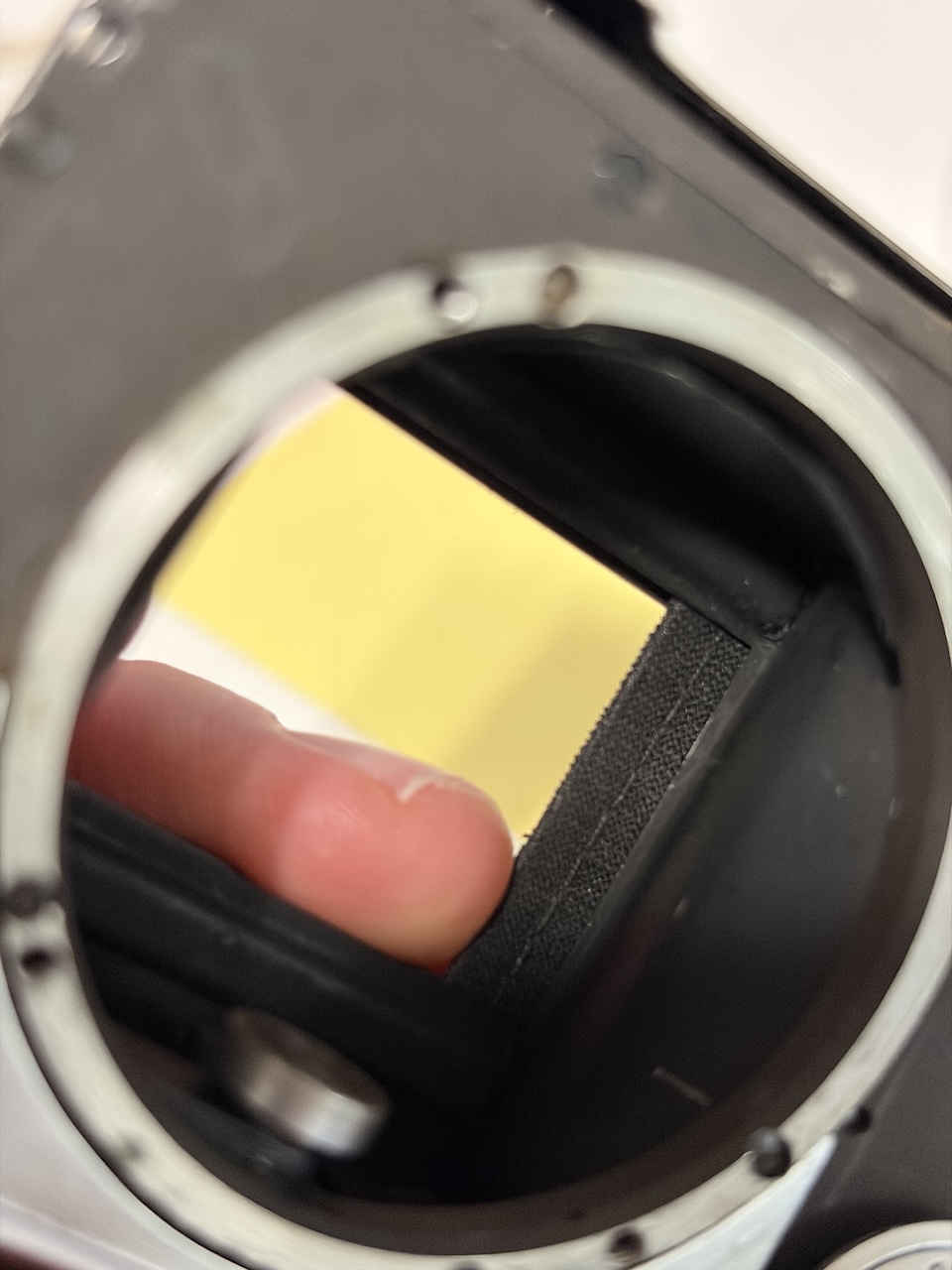
Several careful minutes later with a modelling file and I’d removed the frayed edges, blown away the detritus and finally began the slow process of putting it back together. It turns out this particular model having a self-timer was the worst part by far. The rest came together easily (Leica really know how to make a repairable camera), but I spent about 15 minutes swearing and getting the self timer back in place. An irony, given I never use it and genuinely wish it wasn’t there.
Finally, it was done and I loaded up a roll of film to take over the next few days. I didn’t take anything important, as I wasn’t sure I hadn’t entirely screwed up the shutter mechanism. To my delight, however, when I developed and scanned it yesterday, I found that not only was the shutter timing still as good as before, but no streaks were visible on any shutter speeds.

And so, I have a working Barnack Leica again. I don’t know that I’ll make a habit of repairing cameras (I am not made for fiddly repairs, I’ve concluded) but it was a very satisfying thing to do, and saved me $250 AUD or more.
** For a fun bit of extra trivia - looking up the serial number of this specific camera, it was manufactured as a Leica IIf (basically, missing the slow shutter speed dial on the front) and had therefore probably been sent back to Leica for an upgrade at some point after purchase.