Notes on Film 1 - Into the Jungles
Note: Yes, I know I wrote a complaint about ’everyone reviewing things’, and especially how ‘reviewing’ things meant I stopped enjoying them. I’m starting a new little series here, not to review films I watch, but to provide some thoughts on films I am re-watching. I’m going to putt them in sets, I think, several at a time. So, here’s the first bunch:
Sorcerer (1977) and The Thin Red Line (1998)
Two films shot in jungles, 20 years apart. Both with protracted and difficult productions. Difference is, at the time it came out Red Line had praise (rightly) heaped on it; Sorcerer took a critical re-appraisal years later to be given its due.
Sorcerer (1977, William Friedkin)
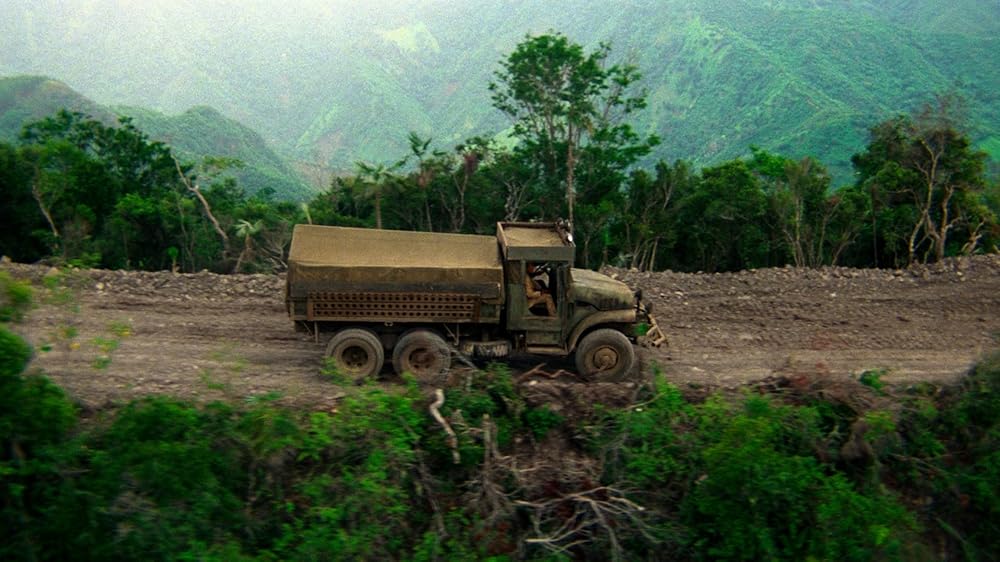
Friedkin’s Sorcerer is a film I love more and more every time I see it. It’s depressing, nihilistic, rich in visual texture, and tense beyond belief. If you ever need to argue the value of shooting on actual film, this title would have to be on your list.
It’s also something else that leapt out to me as I was reading a few things about it after this re-watch: it’s Peak ’70s Film. Before Star Wars dropped a nuclear bomb on the entirety of cinema, the ’70s was home to New Hollywood, the collective term for a lot of very talented young (mostly) men who were suddenly thrown decent sized budgets and let free to do all manner of dramas and thrillers.
What they often have in common, whether they’re crime films like Friedkin’s own The French Connection, neo-noirs like The Long Goodbye, or gangster films like The Godfather, is a kind of brutal nihilism that befits the ’70s. In the US, faith was being lost in institutions and financial crises hit hard (two things definitely familiar to people reading this in the 2020s), and these feelings were often reflected in these films.
Somehow, Sorcerer, coming right at the end few months before Star Wars appeared and changed everything, ends up also feeling to me like the absolute final form of this specific kind of film. It has the nastiness, the nihilism, and even the ambiguous but certainly down-beat ending.
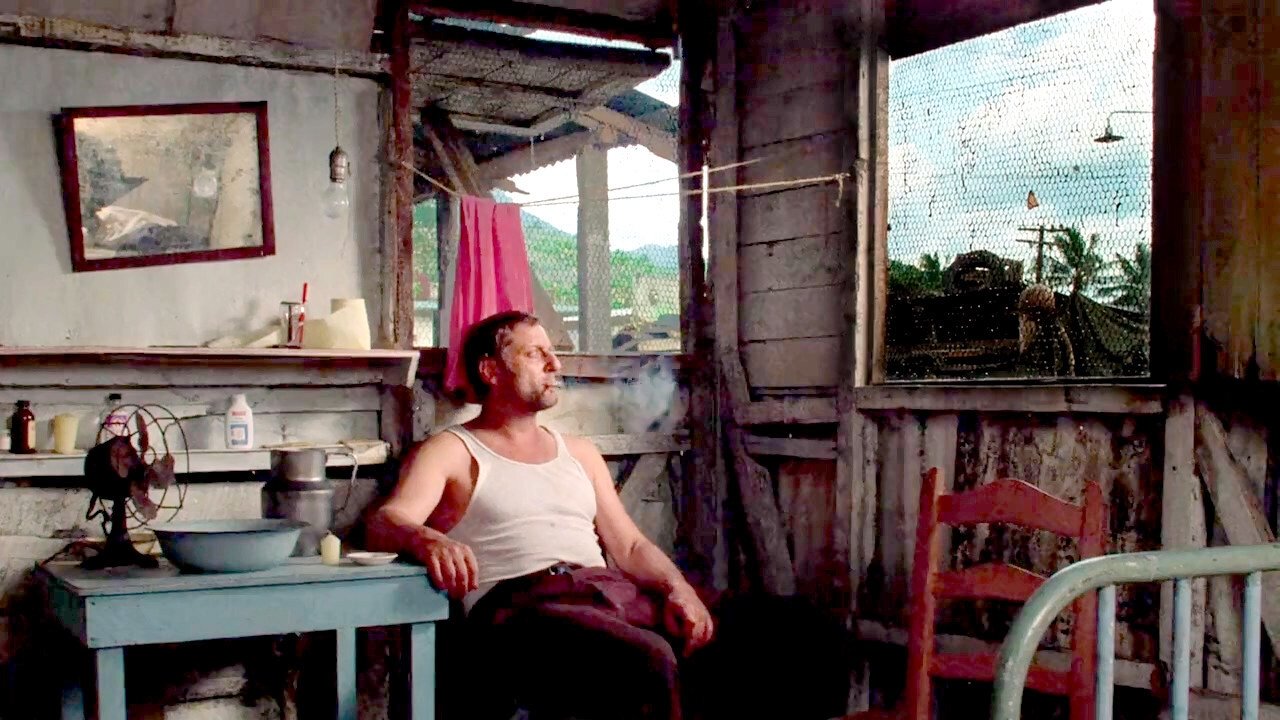
But it somehow goes even further than this - in the film Roy Scheider’s character almost gains some hope. When all is lost, he has one chance to accomplish something which may grant him the life he’s lost. It’ll give him the money to leave, start anew, and maybe begin to make up for everything he loses in his part o the film’s opening act.
It’s not just that he comes so close - it’s that the film knows this, and right at the end gives us that absolutely beautiful, push-in to an extreme close-up. It lingers there, and we can see in his haunted eyes that even succeeding at this has destroyed him in a way that can never be repaired. Perhaps, then, if the film’s conclusion is what it appears to be in that final shot, he was saved from the trauma he’s left with.
The Thin Red Line (1998, Terrence Malick)
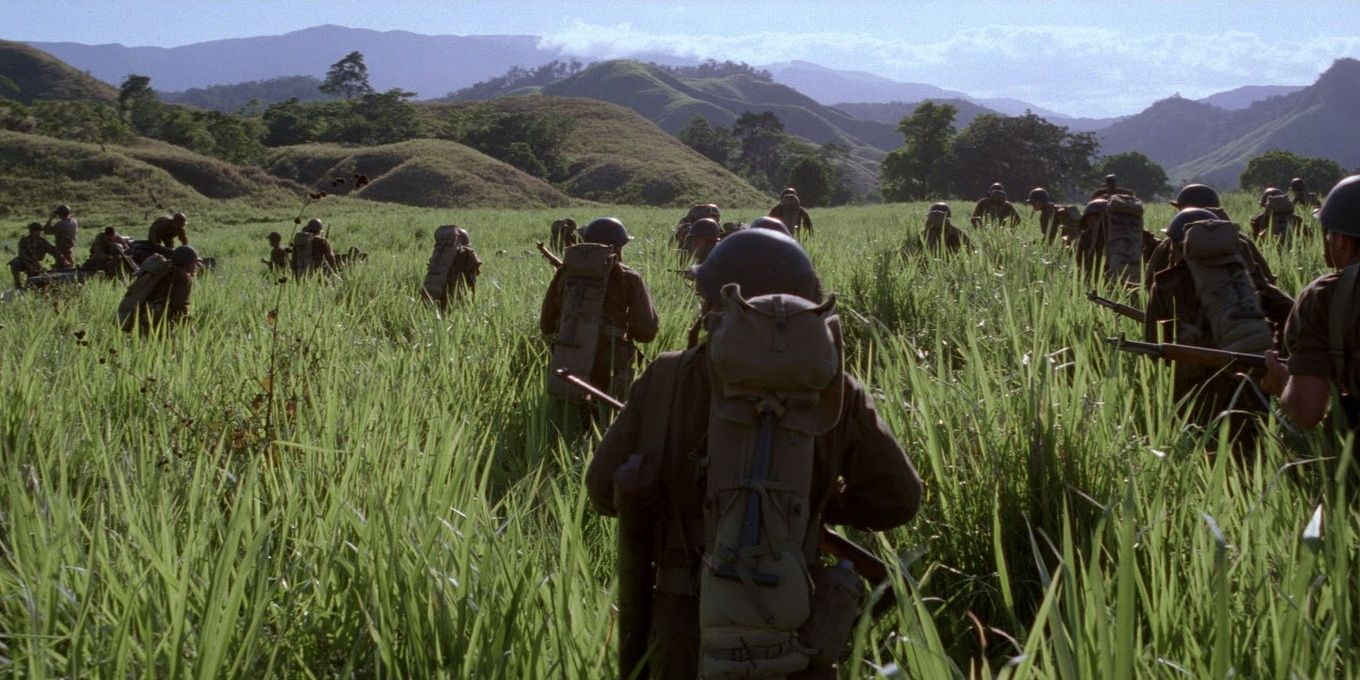
This was a film that went right over my head when I first watched it as a 16 or 17 year old. It seemed slow, confusing and not as exciting as other war films. I suspect like most people, I grew into this one. Despite knowing I loved it enough to want it on blu-ray, I’d actually never watched that blu-ray until now. Which means, I think, that I hadn’t watched this film since I was doing so on low-quality DVD. Going over it this time, I had a few thoughts:
God’s Eye View
During the first battle sequence in the movie, Malick uses a very steady camera, craning up over the soldiers as they charge the hill, taking small arms and mortar fire. In contrast to the “you’re actually there” shaky-cam of Spielberg’s Saving Private Ryan just a year earlier, Malick’s incredibly stable and true camera gives us a very different feeling.
We can see clearly what’s going on. Soldiers weave, dodge, hit the deck, move, fall down shot, or get blasted out of frame. But no matter what happens to the troops, we, the audience, maintain our clear view. The camera moves slowly, steadily, almost ominously. It reminds me of David Fincher’s frequent style of camera. As he puts it, “It’s like what you’re seeing was meant to happen - it was doomed to happen.”
That’s what it feels like, watching some of the battles in this film. You are God, watching with dispassion and little emotional connection. It works marvellously, because of the contrast with just how beautifully poetic the film is.
Fighting at Home
There’s a lot of World War 2 films, and over the years I have seen probably more than my fair share of them. The thing that often makes them seem foreign to me is that most of the time they occur in places I’ve never been. Like, say, the entirety of Europe. Or even the UK, if it’s a home-front drama. This means that what’s probably a pretty standard image for someone else, like some lush green hedge rows and rolling hills, looks quite foreign to me.
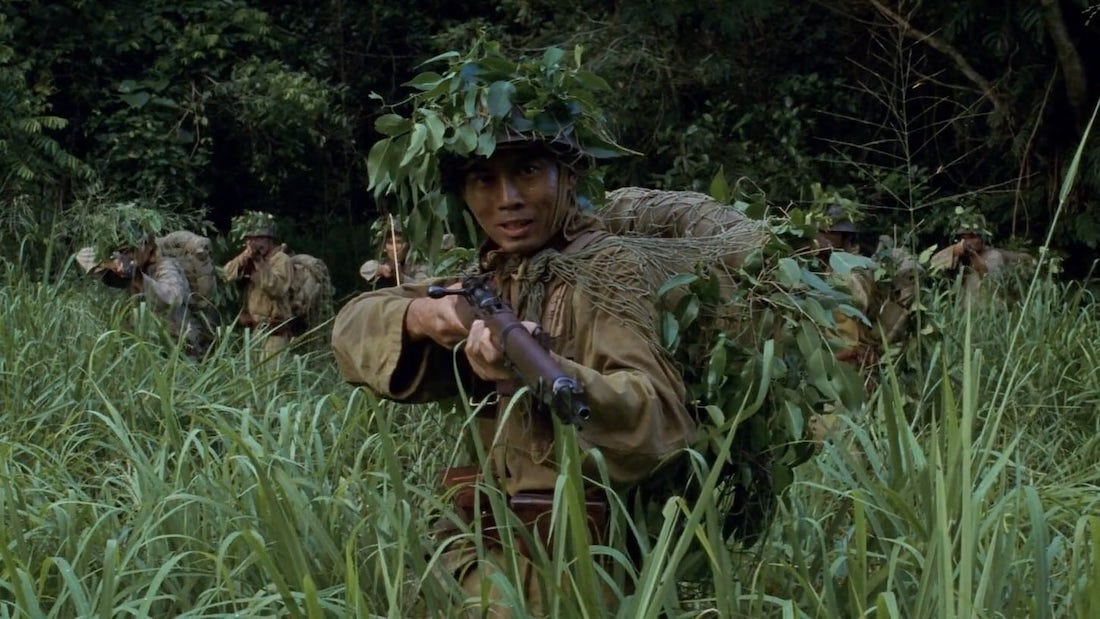
The Thin Red Line is one of several Pacific-set WW2 films that was shot in Far North Queensland, a place I am fairly familiar with. In fact, I’ve stayed and traipsed around the primary shooting locations of the film. This means that not only are these tropical jungles not ‘foreign’ to me but remind me of home (or at least, another part of my own country that I very much love). Even knowing these events actually took place in the Solomon Islands, seeing trees I know, landscapes I know and animals I know makes the fighting seem both more real to me - and more uncomfortable.
The Animals See All
Speaking of animals, Malick’s constant cut-aways to generally-disinterested animals before, after or even during battle sequences also had an interesting effect on me as I watched them. Whatever awful things were going on, and no matter how many characters I cared about die, it somehow helped to see these animals, especially ones I’m used to seeing. “Oh hey, it’s a Crimson Rosella!”.
Whatever happens, at least those animals will be okay. (Well, presuming most of them run away when the shooting starts and don’t get taken apart by 8cm mortar fire.)
How Films Age
Another interesting thing about Thin Red Line is its cast. This was Malick’s first film in twenty years, and his earlier ones had reached god-tier level of reverence within Hollywood. As a result, apparently every actor around through themselves at him. As a result, many fantastic actors appear in almost bit-parts, and the actors he cast in the main roles were either relatively unknown then, or at least have grown in stature since.
So watching it now, it’s hard not to constantly notice faces you know. From local boys like Kick Gurry and Matt Doran, to character actors like Tim Blake Nelson and Nick Stahl. When the film came out, they were just faces. Now they’re familiar.
It’s another way films can age - that over time, your knowledge of the faces appearing in an old film become stronger and warmer. You care more about these often nameless men being sent to die in a jungle, because you recognise them.
It’s only improved the film now, twenty years on.